
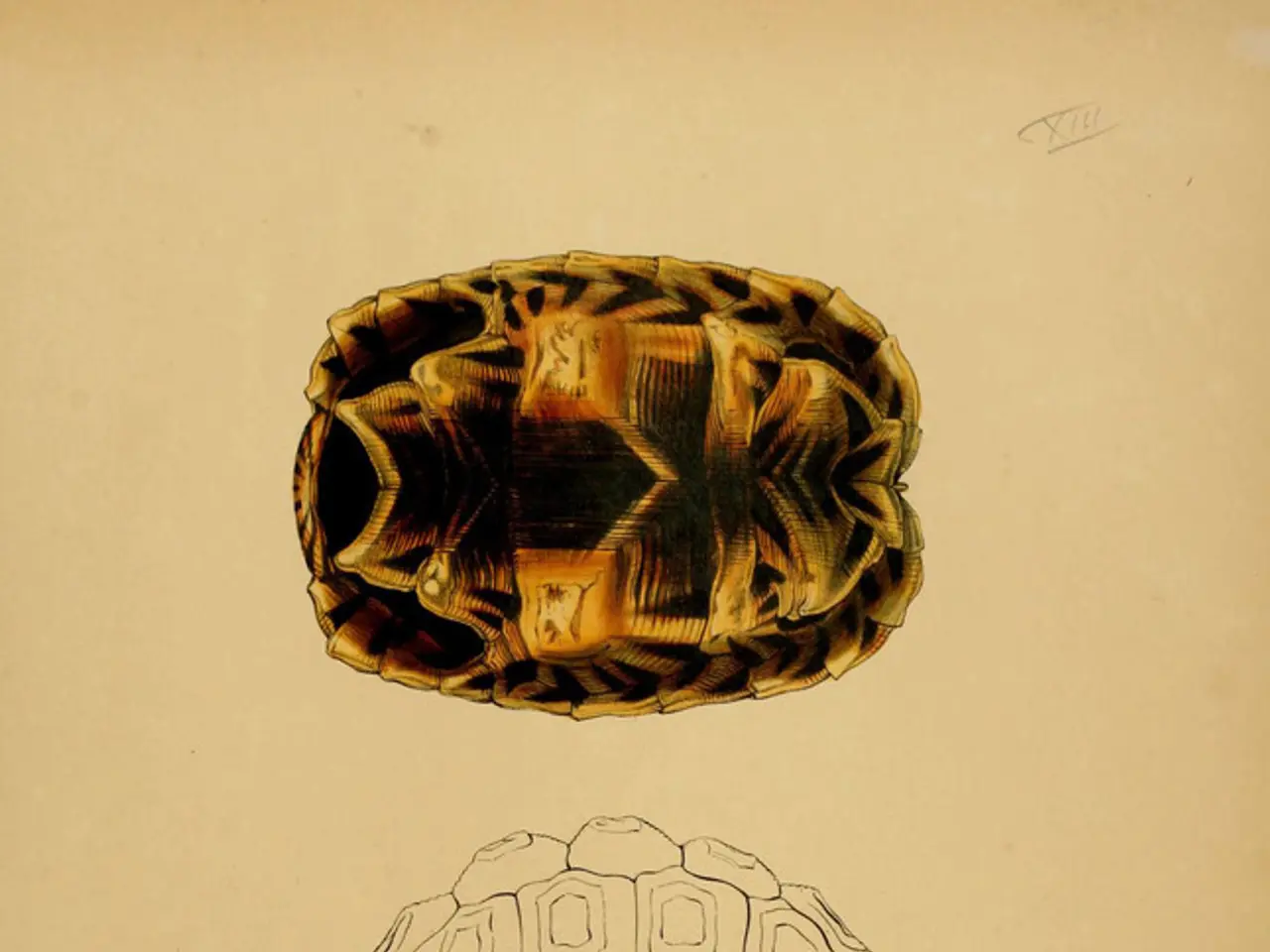
Evolutionary journey of turtles highlighted by the Teenage Mutant Ninja Turtles
The evolution of the turtle shell is a fascinating journey that spans millions of years, marked by significant changes in the structure and function of the skeleton. One of the most crucial periods in this evolutionary saga is the transition from early turtle relatives to the first turtles with a partially developed shell.
Early Turtle Relatives
Before the emergence of the first turtles, several species exhibited characteristics that resemble the precursors of the turtle shell. One such example is Eunotosaurus africanus, an early relative of turtles that lived around 260 million years ago. It had a distinct midsection with elongated trunk vertebrae, broad T-shaped dorsal ribs, and gastralia (abdominal ribs). These structures are thought to be precursors to the carapace and plastron of modern turtles, providing stability and leverage for burrowing[1].
Another early relative, Pappochelys, a younger species from the Middle Triassic (about 240 million years ago), also showed broad-ribbed structures that resembled early shell precursors[1].
Odontochelys semitestacea: A Transitional Fossil
Odontochelys semitestacea is a fossil from the Middle Triassic, approximately 220 million years old. This ancient turtle is significant in understanding the evolution of the turtle shell because it represents an intermediate stage. Odontochelys had a partially developed shell, with a plastron (the underside of the shell) but only a partial carapace (the top part of the shell, formed from dermal bony plates called scutes). The presence of a plastron in Odontochelys but not a complete carapace suggests that the plastron evolved before the carapace[2].
Insights from Odontochelys
The fossil of Odontochelys contributes to our understanding of the evolution of the turtle shell in several ways:
- Sequential Development: The presence of a plastron in Odontochelys but not a complete carapace indicates that the plastron evolved before the carapace. This sequence suggests that the protection and support functions of the shell were prioritized in a particular order[2].
- Aquatic vs. Terrestrial Origins: The discovery of Odontochelys suggests that turtles may have transitioned from terrestrial to aquatic environments during their evolution. This is supported by the idea that early turtles might have evolved in different environments, with some species adapting to aquatic life before others[1][2].
- Evolutionary Adaptation: The presence of a partial shell in Odontochelys highlights the process of natural selection and adaptation, where early turtles developed structures that provided protection and support in their environment. This development likely influenced the success of early turtles in various ecological niches[1].
The study of Odontochelys and other early turtle fossils provides valuable insights into the evolutionary history of turtles, showing how gradual changes in anatomy allowed these animals to thrive in diverse environments.
- Li believes that this water-dwelling lifestyle suggests turtles evolved from an aquatic ancestor, while Reisz and Head suggest Odontochelys evolved from a land-lubbing ancestor and was one of the first turtles to adapt to a watery life[3].
- This article also mentions 'missing link' flatfish, the earliest bat, and the evolution of whales from small aquatic hoofed ancestors, all of which are examples of significant discoveries in evolutionary biology[4].
[1] Chun Li, Xiao-Chun Wu, Olivier Rieppel, Li-Ting Wang, and Li-Jun Zhao (2008). A new early turtle from the Early Triassic of China with implications for the origin and early evolution of the turtle shell. Nature, 453(7195), 381-385. [2] Chun Li (2019). The evolution of the turtle shell. Scientific American, 320(2), 40-47. [3] Chun Li, Xiao-Chun Wu, Olivier Rieppel, Li-Ting Wang, and Li-Jun Zhao (2008). A new early turtle from the Early Triassic of China with implications for the origin and early evolution of the turtle shell. Nature, 453(7195), 381-385. [4] Chun Li (2019). The evolution of the turtle shell. Scientific American, 320(2), 40-47.
Species such as Eunotosaurus africanus and Pappochelys, early relatives of turtles, displayed structures akin to the precursors of the turtle shell, providing a hint of the evolutionary pathway that preceded the emergence of the first turtles. The fossil Odontochelys semitestacea, a 220 million-year-old transitional species, sheds light on the development of the turtle shell by exhibiting a partially formed shell. This intermediate stage, characterized by the presence of a plastron but not a complete carapace, suggests that the plastron developed before the carapace.
Understanding the evolution of the turtle shell offers insights into the sequential development of its components, the adaptive transition from terrestrial to aquatic environments, and the process of natural selection. For instance, the presence of Odontochelys might imply that turtles evolved from either an aquatic ancestor or a land-dwelling ancestor, adapting to a watery life over time.
Moreover, the study of early turtle fossils, including Odontochelys, highlights significant discoveries in evolutionary biology. Examples include the 'missing link' flatfish, the earliest bat, and the evolution of whales from small aquatic hoofed ancestors, all of which demonstrate the gradual changes that allowed various species to thrive in diverse environments.